|
Attribute |
Details |
|
Brand Name |
Supaboard |
|
Website |
supaboard.ai |
|
Category |
AI-Powered Business Intelligence (BI) Platform |
|
Founder |
Aritra (publicly associated with the brand) |
|
Launch Date |
February 5, 2026 (Product Hunt launch) |
|
Core Function |
Agentic BI that turns plain English questions into dashboards, charts, and reports |
|
Data Connections |
600+ data sources (databases, CRMs, payment tools, analytics, spreadsheets) |
|
Starting Price |
$71/month (yearly) or $85/month (monthly) on the Individual plan |
|
Free Trial |
14-day free trial available, no credit card required |
|
Best For |
Founders, product managers, marketers, finance and ops teams who need data answers without SQL |
|
Notable Recognition |
#1 Product of the Day and #1 Product of the Week on Product Hunt at launch |
|
ICON POLLS Rating |
3.7 / 5 |
What Is Supaboard?
Supaboard is an AI-powered business intelligence platform that lets you ask questions about your company data in plain English and get back charts, KPIs, dashboards, and written insights. The brand calls itself an Agentic BI platform, which basically means the AI does not only run queries, it also understands your business logic, your metrics, and your rules.
In practice, you connect your data sources (think PostgreSQL, MySQL, Shopify, Stripe, Google Analytics, Salesforce, Notion, BigQuery, Redshift and many others), train a small AI agent on your business definitions, and then start typing questions like "What was our churn rate last quarter by customer segment?" or "Which marketing channel had the best ROI this month?" The platform writes the SQL or NoSQL query for you, runs it, and returns a chart with a short explanation.
The pitch is simple. You should not need to be a data analyst, or wait three days for one, just to find out how your business is doing.
Supaboard AI: How Smart Is It Really?
The AI layer is the heart of Supaboard, and it is genuinely the part that feels different from older BI tools.
Plain English queries that actually work. We tested basic questions like total revenue by month, top customers by spend, and conversion rate by traffic source. The AI handled all of these without any tweaking. It generated the right query, picked a sensible chart type, and returned a short summary explaining what the numbers meant.
Industry-trained AI analysts. Supaboard ships with pre-trained agents for e-commerce, finance, logistics, SaaS, product, sales, growth, and more. According to Supaboard, users can choose from up to 35 industry-specific agents. These come with built-in domain logic, so a finance agent already understands what gross margin and burn rate mean without you having to spell it out.
Custom agents on Business and Enterprise plans. If your company has its own way of measuring things (and most do), you can train a custom agent by feeding it your metric definitions, KPI formulas, and business rules. This is where Supaboard starts to feel less like a chatbot and more like a teammate that already knows your playbook.
Honest limitation. The AI is only as good as the data you give it. If your tables have inconsistent naming, missing fields, or duplicate records, the answers will be off. Several reviews noted this and we ran into the same issue. Clean data in, clean answers out.
Overall, the AI feels well-built and surprisingly accurate for a platform that only launched in February 2026.
Dashboard and Visualization
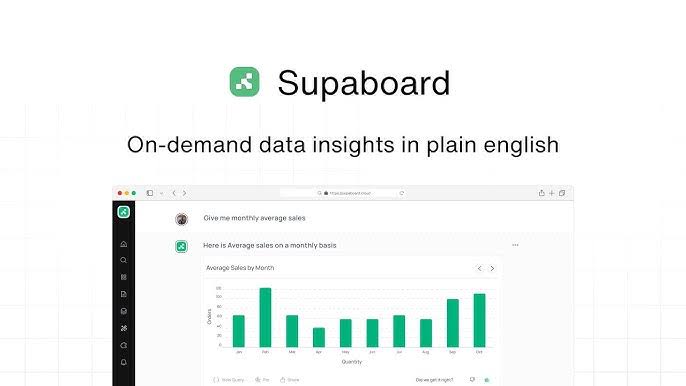
Supaboard does not stop at one-off answers. Every chart you generate from a question can be pinned to a dashboard, and dashboards can be shared with your team or embedded in another product.
Real-time updates.
Dashboards refresh as the underlying data changes, so you are not staring at numbers from last Tuesday.
Live decks.
You can share a dashboard as a live presentation that includes a chat option, which means stakeholders can ask their own follow-up questions instead of pinging you for a new report.
Visual library.
There are over 15 chart types, filters, drill-downs, and themes. It is not Tableau-deep on advanced statistical visualizations, but it covers what most business teams actually need.
Embeddable analytics.
Business plans support AI-powered embeds. Enterprise plans support full white-labeling, which means you can drop Supaboard inside your own SaaS product without showing the brand.
Role-based access.
Editors can build and modify dashboards. Viewers can only consume what is shared with them. There are also audit logs and granular permissions, which matter the moment your team grows past five people.
If you have used older tools where building a dashboard means dragging widgets around for an hour, Supaboard is a clear step up. You describe what you want to see, and the platform builds it.
Supaboard Pricing in 2026
Supaboard has three public plans plus a custom Enterprise tier. Pricing is per workspace on the lower tiers, not per seat, which is unusual in this category and works in favor of small teams.
|
Plan |
Price |
Best For |
Key Features |
|
Individual |
$71/mo (yearly) or $85/mo (monthly) |
Solo users and small teams testing AI BI |
Single user, default agent, advanced AI models, unlimited dashboards, static embeds, email support |
|
Business |
$191/mo (yearly) or $229/mo (monthly) |
Growing teams that need collaboration |
Multiple users, custom agents, AI-powered embeds, collaborative dashboards, priority support |
|
Enterprise |
Custom pricing |
Larger SaaS companies and regulated industries |
Unlimited agents, full white-labeling, SSO, HIPAA BAA add-on, dedicated CS manager |
Is it worth it? At $71 a month, the Individual plan is not the cheapest BI option on the market. Metabase has a free self-hosted version. Hex starts at $28 a month. But Supaboard is cheaper than Tableau ($75 per user, per month) and far cheaper than Looker, which usually starts in the thousands. The honest framing, used by several reviewers we cross-checked, is this: Supaboard is not competing with free tools, it is competing with the cost of hiring a part-time analyst. Looked at that way, even the Business plan at $191 a month pays for itself the moment it saves you one analyst hour.
Free trial. There is a 14-day free trial, no credit card required. We recommend using the trial to connect your real data sources, not a demo dataset, because the real value of the AI shows up when it is reasoning about your business.
Login and Onboarding Experience

Getting into Supaboard is straightforward. You sign up at supaboard.ai, log in through email or Google, connect a workspace, and pick the data sources you want the AI to access. The login page is clean and the sign-in flow does not throw extra steps at you.
Read-only by design. Supaboard connects to your databases with read-only access and only stores schema metadata, not your actual rows. That is an important security detail and one of the reasons the platform is being adopted by teams in finance and healthcare.
OAuth and SSH support. Most popular data sources connect through OAuth, and self-hosted databases can connect through SSH tunnels. Enterprise customers also get SSO.
Onboarding speed. From sign-up to first dashboard, we were under 30 minutes for a basic Postgres connection. That is dramatically faster than the weeks-long setup typical of legacy BI tools.
If we had to flag something, it would be that the very first agent training step can feel intimidating if you have never written down your business logic before. Supaboard provides templates and the docs are decent, but expect to spend an hour getting your definitions right if you want the AI to be useful from day one.
User Experience
This is where Supaboard quietly wins. The interface is calm. The navigation is small. The chat box sits front and center, and most workflows happen in two or three clicks.
Chat-first design.
The main interaction is a question, an answer, and a chart. Everything else builds out from that.
Mobile-friendly dashboards.
Dashboards render well on phones, which is rare for BI tools.
Clear data lineage.
When you ask a question, Supaboard tells you which tables and columns it pulled from. That builds trust, especially for finance and ops users.
Slack and Teams integrations.
You can push answers and dashboards directly into team channels, which keeps reporting where conversations actually happen.
Areas to improve.
Some advanced visualizations and scheduled report features are still rolling out. Heavy data engineering teams will miss certain SQL editor power-features that mature tools like Hex offer. And, like every chat-based tool, the AI occasionally needs a follow-up question to fully nail a complex query.
On the whole, the experience feels modern and approachable. A non-technical founder can use it. A growth marketer can use it. A finance manager can use it. That is the point, and Supaboard mostly delivers on it.
Pros and Cons of Supaboard

What We Liked
Plain English queries return accurate, well-visualized answers.
Industry-trained AI agents shorten setup time massively.
600+ data source integrations cover almost any modern stack.
Embedded analytics and white-labeling on higher tiers are genuinely useful for SaaS companies.
Read-only connections and granular permissions keep data secure.
Onboarding takes hours, not weeks.
What Could Be Better
Pricing starts higher than open-source alternatives, which may exclude very small budgets.
The platform is new (launched February 2026), so some features like advanced scheduling are still maturing.
AI quality drops if your underlying data is messy or inconsistent.
Customer support is mostly online and email-based on lower tiers, with priority support reserved for Business and above.
Currently only supports English.
ICON POLLS Final Rating: 3.7 / 5
Supaboard is a strong, modern BI tool with a clear identity. It is not trying to replace every Tableau use case. It is trying to give the rest of the company, the people who do not write SQL, a way to actually use the data sitting in the company database. On that promise it largely delivers.
|
Category |
Score (out of 5) |
|
AI Capability |
4.0 |
|
Dashboard and Visualization |
3.8 |
|
Pricing and Value |
3.3 |
|
User Experience |
3.9 |
|
Login and Onboarding |
3.7 |
|
Customer Support |
3.5 |
|
Overall Rating |
3.7 / 5 |
If you are a startup founder, product manager, marketing lead, finance manager, or ops team that is tired of waiting on the data team for every report, Supaboard is worth the 14-day trial. If you already have a heavy data engineering team that lives inside SQL all day, you may find Hex or Metabase a better fit.
Either way, Supaboard is one of the most interesting BI launches of 2026, and the trajectory is pointing up.
Frequently Asked Questions About Supaboard (2026)
1. Is Supaboard legit and safe to use in 2026?
Yes. Supaboard is a real company that publicly launched on Product Hunt in February 2026 and now serves teams across SaaS, e-commerce, finance, and logistics. The platform connects to your databases with read-only access and only stores schema metadata, not your raw business data. Larger plans support SSO and a HIPAA BAA add-on, so even regulated industries can use it. Nothing in our research points to Supaboard being unsafe or a scam.
2. How much does Supaboard cost?
Supaboard starts at $71 per month on the Individual plan when billed yearly, or $85 per month if you pay monthly. The Business plan is $191 per month yearly (or $229 per month monthly), and the Enterprise plan has custom pricing. A 14-day free trial is available with no credit card required.
3. Does Supaboard have a free plan?
No, Supaboard does not currently offer a permanent free tier. What is available is a 14-day free trial that gives you full access to the platform without entering a credit card. That window is usually enough to connect your data and decide if the AI gives you trustworthy answers.
4. How do I login to Supaboard?
You can login at supaboard.ai by clicking the Login button at the top right of the homepage. Supaboard supports email and Google sign-in for individual accounts, and SSO for Enterprise customers. If you forget your password, the reset link is sent to the email tied to your workspace.
5. What makes Supaboard different from Tableau, Power BI, or Looker?
The biggest difference is that Supaboard is AI-first and conversational, while Tableau, Power BI, and Looker are dashboard-builder-first. With Supaboard, you ask a question in plain English and get a chart. With the others, you typically drag widgets, write formulas, or use a custom modeling language. Supaboard also has a much faster setup time (hours instead of weeks) and is generally cheaper than Tableau and far cheaper than Looker.
6. How many data sources does Supaboard connect to?
Supaboard connects to 600+ data sources, including PostgreSQL, MySQL, MongoDB, Snowflake, BigQuery, Redshift, Google Analytics, Shopify, Stripe, Salesforce, HubSpot, Notion, Airtable, Slack, and many more. Most connect through OAuth and self-hosted databases can connect through SSH tunnels.
7. Can I embed Supaboard dashboards in my own product?
Yes. Embedded analytics is one of Supaboard's standout features. The Individual plan supports static embeds. The Business plan supports AI-powered embeds where users can interact with the data. The Enterprise plan supports full white-labeling, meaning you can hide the Supaboard brand entirely and present the analytics as your own product feature.
8. Is Supaboard suitable for non-technical users?
Yes, this is exactly who Supaboard is built for. Founders, product managers, marketers, and finance leads can ask questions in plain English and get charts back, no SQL required. The only requirement is that your data is reasonably clean and that someone (you or a teammate) takes the time during setup to define your key business metrics so the AI agent can use them correctly.
9. Who founded Supaboard?
Supaboard is publicly associated with founder Aritra, who has been building the product and engaging with the community since well before the public launch. The company is still small and clearly in growth mode, which is part of why the product is iterating quickly.
10. What is the verdict from ICON POLLS?
Our verdict is 3.7 out of 5. Supaboard is one of the most promising AI-powered BI tools we have tested in 2026. It nails the core promise of turning plain English questions into trustworthy data answers, and it does it without forcing your team to learn SQL or wait on an analyst. The price could be friendlier for very small teams, and a few features are still maturing because the product is new. But for any team serious about data-driven decisions, Supaboard is worth a 14-day trial.