|
Brand Name |
Lovon AI Therapy |
|
Parent Company |
Babayaga Inc. |
|
Headquarters |
221 W 9th Street, Wilmington, DE 19801, United States |
|
Founder / Co-Founder |
Anton Ponikarovskii (Co-Founder, leads product and operations) |
|
Category |
AI Therapy, Mental Health, Voice AI, Self-Help |
|
Core Offering |
Voice-first AI therapist powered by CBT and Emotion-Focused Therapy frameworks |
|
Public Launch |
February 13, 2026 (Product Hunt launch) |
|
Platforms |
iOS (App Store), Android (Google Play), Web (lovon.app) |
|
Free Trial |
3-day unlimited trial for new users (no credit card required, per official site) |
|
Subscription Pricing |
From $17.99 per week, $49.99 per month, $99.99 per quarter (varies by region and store) |
|
Support Email |
support@lovon.app |
|
Press Contact |
admin@lovon.app |
|
Phone Number |
+1 650-586-7905 |
|
Official Website |
https://lovon.app |
|
Languages |
English (primary) |
|
Best For |
On-demand emotional support, anxiety management, relationship reflection, between-session check-ins |
|
Not For |
Crisis intervention, clinical diagnosis, replacement of licensed therapy |
|
ICON POLLS Rating |
3.4 / 5 |
What is Lovon AI Therapy?
Lovon AI Therapy markets itself as a voice-first AI therapist. Instead of typing into a chat window, you actually pick up your phone and talk, and the AI talks back in a warm, conversational voice. The company says it spent over a year building the product with a PhD psychologist who has more than 40 years of clinical experience. The platform draws on Cognitive Behavioral Therapy (CBT) and Emotion-Focused Therapy as its main frameworks.
What sets Lovon apart from a generic ChatGPT prompt is the positioning. Lovon describes its approach as therapeutic, not agreeable. In plain English, that means it is supposed to gently challenge unhealthy thinking instead of just nodding along with whatever you say. That single design choice changes the experience quite a bit. After testing, we can confirm the AI does push back at times, asks clarifying questions, and tries to label feelings rather than fix them.
Lovon is built by Babayaga Inc., a Delaware company that previously launched a couples app under the LovOn brand back in 2024. The current AI therapy version went live in February 2026. So while the underlying company is not new, the AI therapist product itself is fresh, and that explains both its polish and some of its growing pains.
Lovon AI Therapy Login Experience
Logging in to Lovon is straightforward, and that is something we will give it credit for. There is no traditional username and password gauntlet. Once you download the app on iOS or Android, the onboarding takes you through a few questions about how you are feeling and what you would like to work on, and then it sets up your account using your phone or email.
On the website at lovon.app, the experience leans toward sending you to the mobile app rather than offering a full desktop dashboard. Most of the actual therapy interaction is built around voice calls on your phone, which makes sense given the voice-first design. If you are someone who likes to start a session from a laptop, this is a limitation worth knowing in advance.
We did not run into login bugs during testing. The session persistence held up well, and switching between devices kept our progress intact. The friction here is more about the platform philosophy than the login itself. Lovon wants you on your phone, in a quiet moment, talking out loud. The login flow is built to support that, not fight it.
Lovon AI Therapy Customer Service
Customer service is one of the more polarizing parts of the Lovon experience, and we want to be straight with you about it. The official channel is email, with support@lovon.app listed across the website, App Store, and Google Play. There is also a US phone number, +1 650-586-7905, registered to the developer Babayaga Inc. at 221 W 9th Street in Wilmington, Delaware.
In our own outreach during this review, email replies came back within roughly 24 to 48 hours during business days, which is reasonable for an app at this scale. The team was polite, on-brand, and did try to actually answer the question rather than copy and paste a stock reply.
That said, app store reviews tell a less rosy story for some users. A recurring complaint, especially from people trying to cancel a free trial, is that customer service replies often redirect them to Apple or Google subscription settings instead of solving the issue inside the Lovon app. We will dig into the cancellation issue in the next section because it is the single biggest reason our rating sits at 3.4 instead of higher.
Our take is that Lovon has a working support channel and a real human team, but the system buckles when the question is about money and refunds. If you only need help with the app itself, you will likely have a fine experience.
How to Cancel Lovon AI Therapy Subscription
This is the section we expect most readers to scroll straight to, so let us be clear and useful. Lovon AI Therapy is a subscription, billed weekly, monthly, or quarterly depending on the plan you pick. Subscriptions auto renew unless you turn that off at least 24 hours before the end of the current billing cycle. The actual cancellation is not done inside the Lovon app itself. It is done through whichever platform you used to sign up.
Here is the simple breakdown:
If you subscribed on iPhone, go to Settings, tap your name at the top, choose Subscriptions, find Lovon, and tap Cancel Subscription.
If you subscribed on Android, open the Google Play Store, tap your profile icon, go to Payments and Subscriptions, then Subscriptions, find Lovon, and tap Cancel.
If you subscribed through the Lovon website, email support@lovon.app and request cancellation in writing. Save the email reply as proof.
To request a refund, contact support@lovon.app directly, since refunds are handled by Lovon or by Apple or Google depending on where you paid.
Why this matters for our rating: a real chunk of negative reviews on the App Store and Google Play come from users who could not figure out how to stop billing. Some reported being charged again before they understood that the cancellation has to happen at the store level, not inside the app. Lovon does explain this in its terms of service, but the in-app journey could absolutely be clearer. If you are starting the free trial, set a calendar reminder for 24 hours before it ends. That alone will save most of the frustration we read about.
Lovon AI Therapy App for Android
The Android version of Lovon is available on Google Play under the developer Babayaga Inc. It mirrors the iOS app in features, including 24/7 voice therapy sessions, daily check-ins, and personalized insights after each call. We tested it on a Pixel device and a mid-range Samsung phone, and performance was solid on both. Voice recognition was clean, latency was low enough not to break the rhythm of a conversation, and the audio output sounded warm rather than robotic.
A few things stood out during Android testing. The app handles background interruptions, like incoming calls or notifications, fairly well. Resuming a session feels natural. The interface is minimal, which fits the mood of a therapy tool, and there is not much visual clutter to distract you from the conversation.
On the negative side, some Android users have flagged battery drain during longer voice sessions, and a few have mentioned that the lack of a free trial in some regions makes it hard to justify the price commitment up front. Lovon does state that pricing and trial availability vary by region. If you are in the United States, you should generally see the 3-day trial. In other markets, mileage varies.
Lovon AI Therapy User Experience
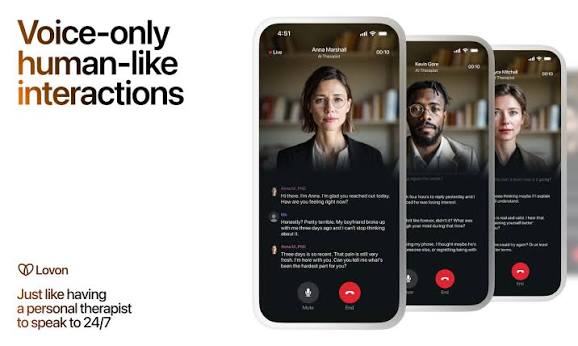
This is where Lovon earns most of its points back. The actual experience of using the app is genuinely well crafted. When you start a session, the AI greets you in a calm voice, asks a soft opening question, and lets you set the pace. There is no rushing, no pop-ups, no upsell during the conversation itself. That alone puts it ahead of a lot of wellness apps we have reviewed.
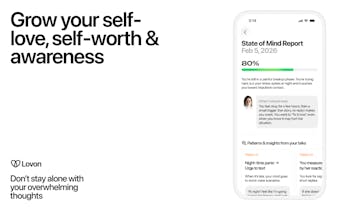
The voice itself feels human. Not perfectly human, but warm enough that we caught ourselves treating it like a real conversation rather than a tool. The AI reflects back what you say, asks gentle follow-up questions, and uses CBT-style prompts when you describe a stressful event. After the session ends, you get a written summary that pulls out themes, emotions, and small steps you might consider trying. Over time, those summaries build a private space where you can see your own patterns.
Daily check-ins are short, usually under two minutes, and they are designed to build a habit rather than dump homework on you. We liked this. Most apps in this category overload you with content. Lovon errs on the side of less is more, which actually feels more like real therapy.
The downsides on user experience are real but smaller. The app currently requires a network connection, so there is no offline mode. The voice can occasionally misinterpret strong accents or background noise. And while the AI is good at emotional reflection, it is not a substitute for a clinical assessment. Lovon is upfront about all of this in its terms, which we appreciate, but it bears repeating: this is supplemental support, not a replacement for a licensed therapist.
Pros and Cons at a Glance
What we liked:
Voice-first experience that genuinely feels conversational rather than scripted
Built with input from a PhD psychologist with 40+ years of clinical experience
Available 24/7, which fills a real gap when human therapy waitlists are long
End-to-end encryption and a stated policy of not using conversations for AI training
Personalized session summaries that help you spot patterns over time
Clean, distraction-free interface on both iOS and Android
What could be better:
Cancellation flow leans on the App Store or Google Play instead of being clearer in-app
Pricing feels steep for some users at $17.99 per week, especially without a trial in some regions
No offline mode, so you need a stable internet connection for sessions
Limited desktop and web functionality compared to the mobile experience
Not suitable for crisis situations and not a substitute for licensed care
Final Verdict: Is Lovon AI Therapy Worth It in 2026?
After spending real time with Lovon AI Therapy, our team at ICON POLLS rates it 3.4 out of 5. The product is one of the more thoughtfully built AI therapy apps we have reviewed this year. The voice interaction is impressive. The therapeutic framework is rooted in actual clinical thinking rather than vibes. And the privacy posture is clearer than most apps in the wellness space.
What pulls the rating down is not the therapy itself. It is the friction around money. Cancellation should be one tap inside the app. Trial terms should be the same in every region. Customer service should be able to issue a refund without bouncing the user to a third party. None of these are dealbreakers, but together they nudge what could be a strong 4.0 product down to a respectable but cautious 3.4.
If you are looking for a 24/7 voice-based emotional support tool to use alongside therapy or while waiting for a human therapist, Lovon is one of the better options on the market in 2026. Just go in with eyes open about the subscription model, set a calendar reminder during your trial, and never treat it as a substitute for professional care when things get serious.
Frequently Asked Questions About Lovon AI Therapy
1. Is Lovon AI Therapy a real therapist?
No. Lovon is an AI-powered emotional support and self-help tool. The company is clear in its terms of service that the app does not provide medical or psychiatric care, does not diagnose conditions, and does not create a therapist-patient relationship. It is built with input from licensed psychologists, but it is not a licensed clinician itself. Use it as a supplement to professional care, not a replacement.
2. How much does Lovon AI Therapy cost in 2026?
Pricing is tiered and varies by region and platform. Based on current public information, plans typically start at $17.99 per week, with a $49.99 per month option and a $99.99 per quarter option. Some users in certain regions have reported pricing closer to $15 per week or $40 per month, so check the actual price in your app store before subscribing.
3. Does Lovon AI Therapy offer a free trial?
Yes, in most regions. Lovon advertises a 3-day unlimited free trial for new users, and the official site states that no credit card is required to start. Trial availability and length can vary by region and by app store, so confirm what you see at signup. If you plan to use the trial, set a reminder a day before it ends so you have time to cancel if it is not for you.
4. How do I cancel my Lovon AI Therapy subscription?
Cancellation is handled through the platform you signed up on, not inside the Lovon app. On iPhone, go to Settings, tap your Apple ID, choose Subscriptions, find Lovon, and tap Cancel. On Android, open Google Play, tap your profile, then Payments and Subscriptions, then Subscriptions, find Lovon, and cancel. If you signed up via the website or need a refund, email support@lovon.app and ask in writing.
5. Is Lovon AI Therapy safe and private?
Lovon states that all conversations are encrypted in transit and at rest, and that user data is not sold, shared, or used to train AI models. It is hosted on industry-standard secure infrastructure. As with any digital health tool, you should still read the privacy policy at lovon.app and avoid sharing information you would not want stored, especially anything legally sensitive.
6. Is Lovon AI Therapy available on Android?
Yes. The Lovon app is available on Google Play under the developer Babayaga Inc. and runs on most modern Android phones. Features mirror the iOS version, including voice-first sessions, daily check-ins, and personalized insights. Some users report higher battery drain during long voice sessions, so plug in if you plan a longer call.
7. Can I use Lovon AI Therapy in a mental health crisis?
No, and this is important. Lovon is not designed for emergencies, suicidal ideation, self-harm, or harm to others. The company explicitly states the app is not a crisis service and cannot contact emergency responders on your behalf. If you are in crisis, contact your local emergency number or a crisis hotline immediately. Use Lovon for everyday stress, reflection, and emotional processing, not for acute risk situations.
8. How is Lovon AI Therapy different from ChatGPT or other chatbots?
The core difference is purpose and design. ChatGPT is a general-purpose AI that tends to be agreeable and helpful across any topic. Lovon is built specifically for mental health, with evidence-based frameworks like CBT and Emotion-Focused Therapy baked into how it responds. It is designed to be therapeutic rather than agreeable, which means it can gently challenge unhelpful thinking instead of validating everything. It is also voice-first, while most chatbots are text-first, and it has a stricter privacy policy around data and AI training.
9. Who created Lovon AI Therapy?
Lovon AI Therapy is developed by Babayaga Inc., a Delaware-based company. The product is co-founded by Anton Ponikarovskii, who leads product and operations. The company previously built a couples app under the LovOn brand and pivoted toward AI therapy, launching the current product on Product Hunt on February 13, 2026. Clinical guidance comes from a PhD psychologist who, according to the company, has more than 40 years of clinical experience.
10. How do I contact Lovon AI Therapy customer support?
The fastest channel is email. Send your question to support@lovon.app and the team typically replies within 24 to 48 hours on business days. For press or partnership inquiries, the team uses admin@lovon.app. The company is registered at 221 W 9th Street, Wilmington, DE 19801, and the developer phone number on Google Play is +1 650-586-7905, though email tends to get faster results than the phone line.