Before anyone knew what it was, Grok 4.2 was already being judged. It sat on AI leaderboards in late January 2026 under codenames like Obsidian and Quantum Crow, picking up results with no brand attached. Then Elon Musk confirmed it, and the anonymity was gone. That's a fitting start for a model whose whole pitch was that it wouldn't stay the same for long.
Now that Grok 4.3 and Grok 4.5 have followed it, 4.2 is easier to judge fairly. The launch noise has faded. What's left is a capable, uneven model with a few strengths nobody else quite matches and a few weaknesses that its beta label never fully covered.
Spec Sheet
| Product | Grok 4.2 (also styled Grok 4.20) |
|---|---|
| Developer | xAI (now SpaceXAI), founded by Elon Musk |
| Public beta | February 17, 2026 |
| Model type | Large language model |
| Parameters | Roughly 1 trillion (reported) |
| Context window | 256K tokens |
| Training hardware | Colossus supercluster, around 200,000 GPUs |
| Where to use it | grok.com and the X app (iOS, Android, web) |
| Consumer plans | SuperGrok $30 a month, X Premium+ $40 a month |
| API pricing | $2 per million input tokens, $6 per million output tokens |
| Icon Polls rating | 3.8 out of 5 |
Obsidian, Quantum Crow and a Post on X
The timeline moved quickly. Grok 4.1 had arrived in November 2025. About three months later, on February 14, 2026, Musk confirmed the new model in a post on X, and the public beta went live three days after that. By March it was reachable through third party API providers such as OpenRouter. By April it was xAI's flagship, a position it held until Grok 4.3 and later Grok 4.5 took over.
It hasn't disappeared. Grok 4.2 is still available through the API for developers who prefer it, even though newer models are now the default for most consumer users.
A Model That Ships Weekly
The most interesting idea here isn't a benchmark. It's the release cadence. xAI built Grok 4.2 around what it calls a rapid learning architecture, designed to fold in user feedback and improve on a weekly basis, with release notes attached to each update. Most rivals, ChatGPT and Claude included, typically work on longer update cycles.
That's a real trade. Weekly change means problems can get fixed fast. It also means the model you rely on on Monday may behave a little differently by Friday, which matters if you've built a workflow around it. Early users did report some inconsistency in tone, and a constantly moving target is one plausible reason.
Four Reasoners, One Answer
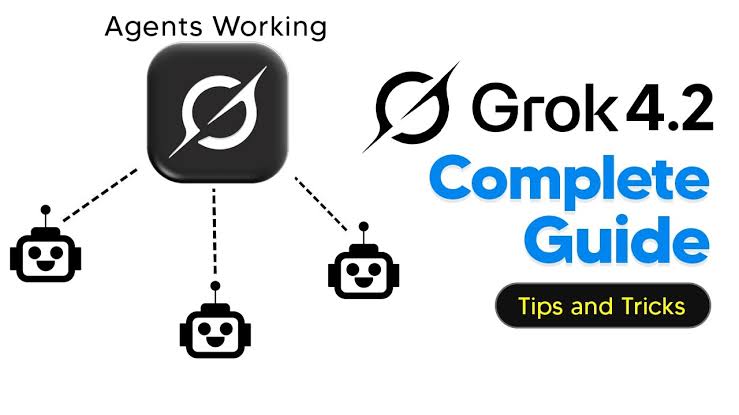
Under the hood, Grok 4.2 uses a four agent parallel reasoning system. In plain terms, it works through several reasoning paths at once and then merges their conclusions into a single response. xAI also applied reinforcement learning at pretraining scale rather than only after training, which the company says gives the model deeper reasoning.
The parameter count is a little murky. The figure usually cited is about 1 trillion, but Musk once described it as "just 0.5t", which suggests different checkpoints or configurations. Either way, it's very large. The 256K context window is the more practical number: long documents, big code files and sprawling conversations fit comfortably, at a time when many competitors offered 128K or less.
The Scoreboard, With Caveats
At launch, the reported numbers were strong:
- SWE bench (coding): 75 percent, narrowly ahead of GPT 5 at 74.9 percent and Claude Opus 4 at 74.5 percent at the time.
- ARC AGI: a reported 15.9 percent, described as the first score past 10 percent on that test.
- Alpha Arena: returns above 12 percent in a live trading competition on real market data, while models from OpenAI and Google lost money.
Look at those SWE bench gaps again. A tenth of a point and half a point are not a different class of model; they're a tie with good marketing. Benchmarks can also be tuned for, and leaderboard results don't always survive contact with everyday use.
The Alpha Arena result is harder to wave away, because it came from live markets rather than a fixed test set. It's still one competition, though, and nobody should read it as a reason to hand a chatbot their savings.
Paying for the Privilege
The apps are free to download from the App Store and Google Play, and grok.com works in any browser. Getting Grok 4.2 itself is another matter. The free tier only covers older Grok models, capped at roughly 10 prompts every two hours. Full access means SuperGrok at $30 a month or X Premium+ at $40 a month. Heavy users can go up to SuperGrok Heavy at $300 a month for priority access and higher rate limits.
On the API side, $2 per million input tokens and $6 per million output tokens is reasonable for a model of this size. For a casual consumer, though, $30 a month asks for a clear reason to choose Grok over a rival you might already pay for.
Living With It
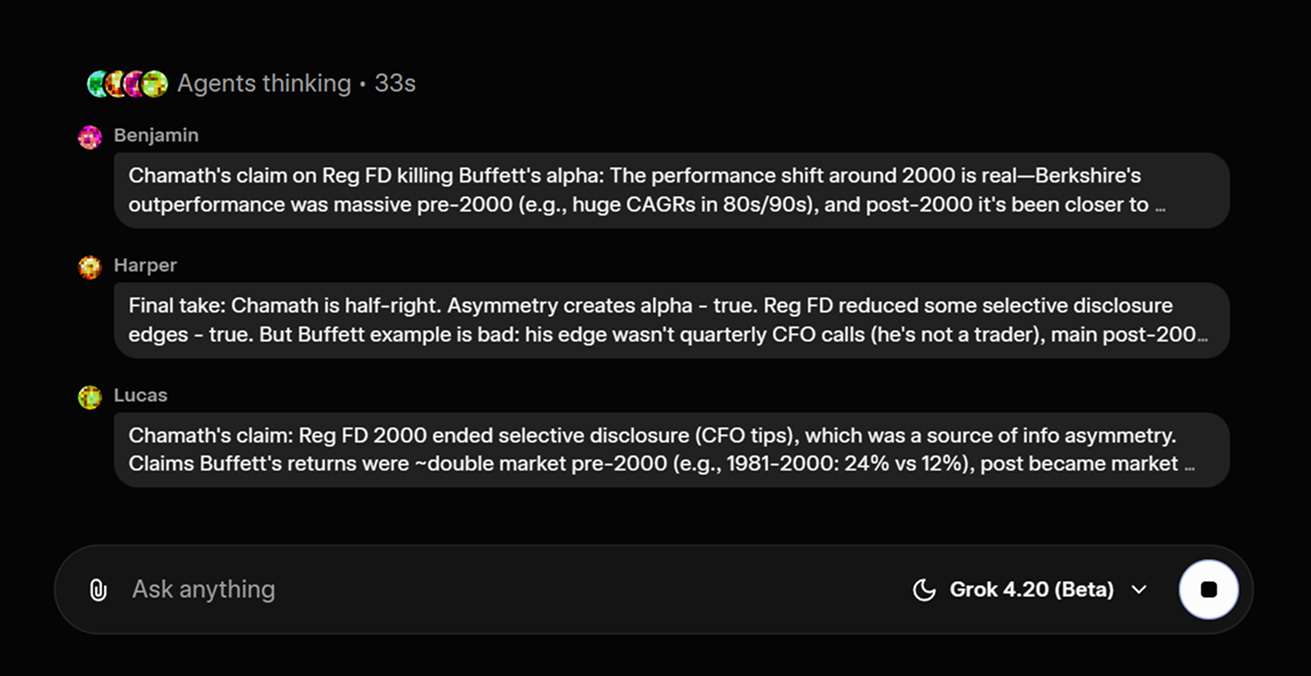
The grok.com interface is clean: pick a model from the dropdown, type, read. Inside the X app it feels squeezed into an interface built for something else, workable if you live on X and a bit cramped if you don't.
The standout is the live connection to X. Ask about breaking news or a trending argument and Grok can pull from what's being posted right now. Nothing else plugs into that particular firehose so directly.
Speed is middling. The design clearly favours reasoning depth, so simple questions can feel slower than they should, and long multi step problems sometimes drag. For coding, debugging and analysis, the wait is easier to accept.
Then there are the guardrails. They're noticeably lighter than Claude's or ChatGPT's. Some people will call that freedom; teams with compliance obligations will call it a risk. The medical analysis feature also comes with no published clinical validation from xAI, so treat it as a curiosity, not a second opinion.
Where It Lands Next to Claude and GPT
Grok 4.2 improved on 4.1 for multi step debugging and tougher engineering questions, and it's at its best in data analysis, financial reasoning and anything that benefits from fresh information. For nuanced, long form writing, Claude and GPT still have a slight edge. Image generation through Imagine and video generation are on the menu too, but they're extras, not the reason to subscribe.
If you enjoy arguing about which tools actually earn a spot in your browser, cast your vote for the world's most useful websites and tell us where grok.com belongs.
Our 3.8, Explained
Icon Polls rates Grok 4.2 at 3.8 out of 5. The points it earns are real: the X data link, competitive coding results, a generous context window and a genuinely different approach to updates. The points it loses are real too: beta roughness, a steep consumer price, light safety rails and rivals that feel more polished for everyday work.
For developers, traders and anyone who needs to know what happened an hour ago, it's a serious option. For everyone else, the competition is smoother at a similar or lower price.
Can I still use Grok 4.2?
Yes. It remains available through the API, although Grok 4.3 and Grok 4.5 are now the default choices for most consumer users.
Is Grok 4.2 free?
No. The free tier only covers older Grok models with limited prompts. Grok 4.2 requires SuperGrok ($30 a month) or X Premium+ ($40 a month).
What is it best at?
Coding, financial and data analysis, and questions about current events, where its live link to X gives it an advantage.